Nine worlds • One speed of light
The level ladder is the solar system.
Every world drives at the real one-way light time of a documented moment. The farther out, the longer each command takes, the rougher the ground and the smaller the science ring. Live distances below are computed in your browser from NASA JPL orbital elements.
-
01 Open from the start
The Moon
Mare Imbrium · near side
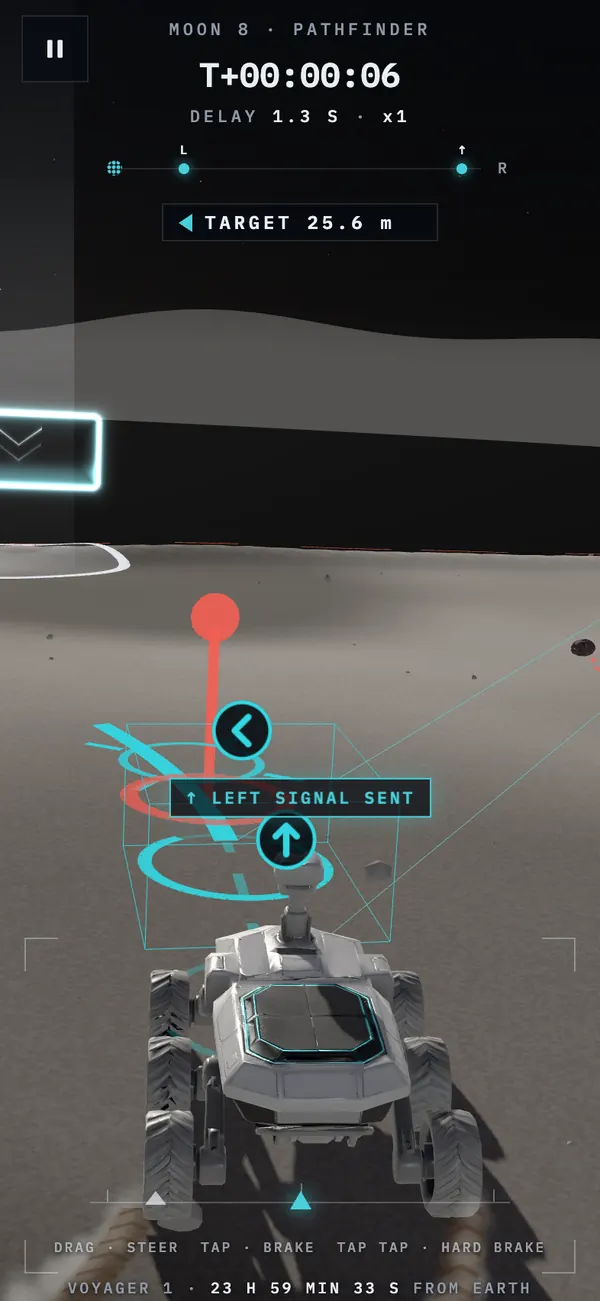
The only world you drive in real time: no compression, just the light delay. On 17 November 1970, Lunokhod 1 rolled onto this mare, driven live from Earth by a crew who saw the ground in single TV frames. Steer round the craters and stop in the science ring.
- Real one-way light
- 1.3 s (Lunokhod 1, 1970)
- Today, live
- 1.3 s
- Time factor
- x1, real time
- On screen
- 1.3 s
- Science ring
- 3.0 m radius
- Drive
- Moon drive
Real robots here: Lunokhod 1 and 2, Yutu-2, Pragyan
-
02 Open from the start
Mars
Jezero crater · science drives
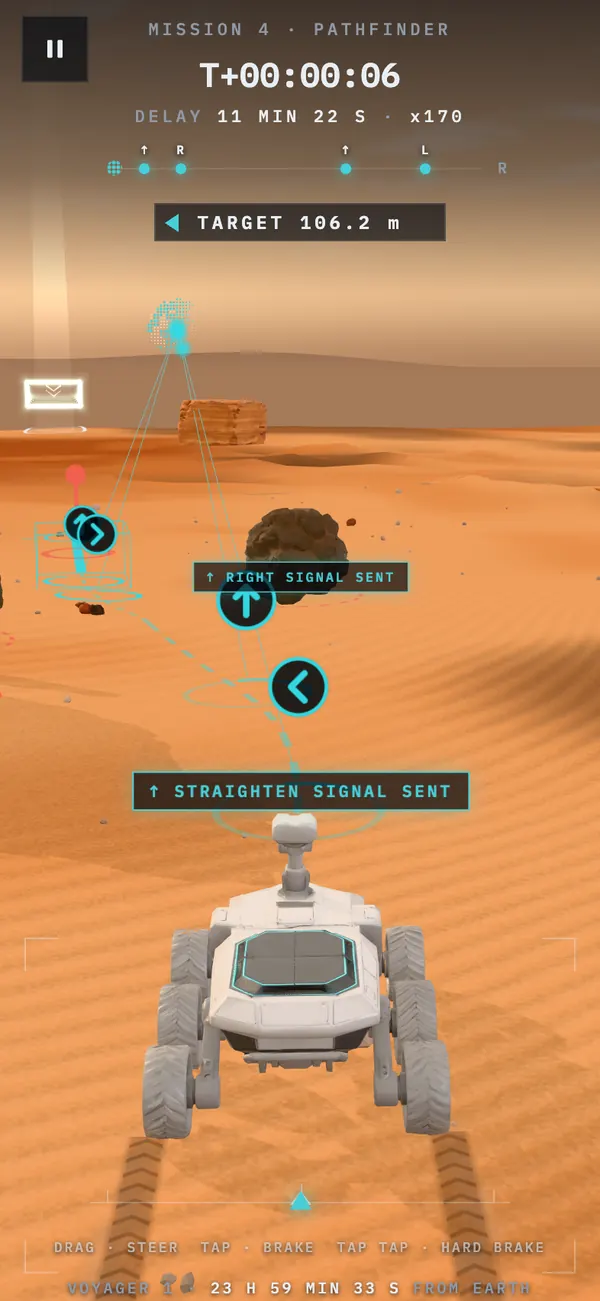
Your fleet's home. Missions drive at the light time of Perseverance's landing day, 11 minutes 22 seconds each way. Reach the science ring and stop inside it, then take on photo missions that bring pictures home and core drills that seal samples from the target layer.
- Real one-way light
- 11 min 22 s (2021)
- Today, live
- 11 min
- Time factor
- x170
- On screen
- 4.0 s
- Science ring
- 2.5 m radius
- Drive
- Science drive
Real robots here: Perseverance and Ingenuity in Jezero crater; Sojourner, Spirit, Opportunity, Curiosity and Zhurong elsewhere on Mars
-
03 24 stars on Mars
Venus
Phoebe Regio · 464 °C at the ground
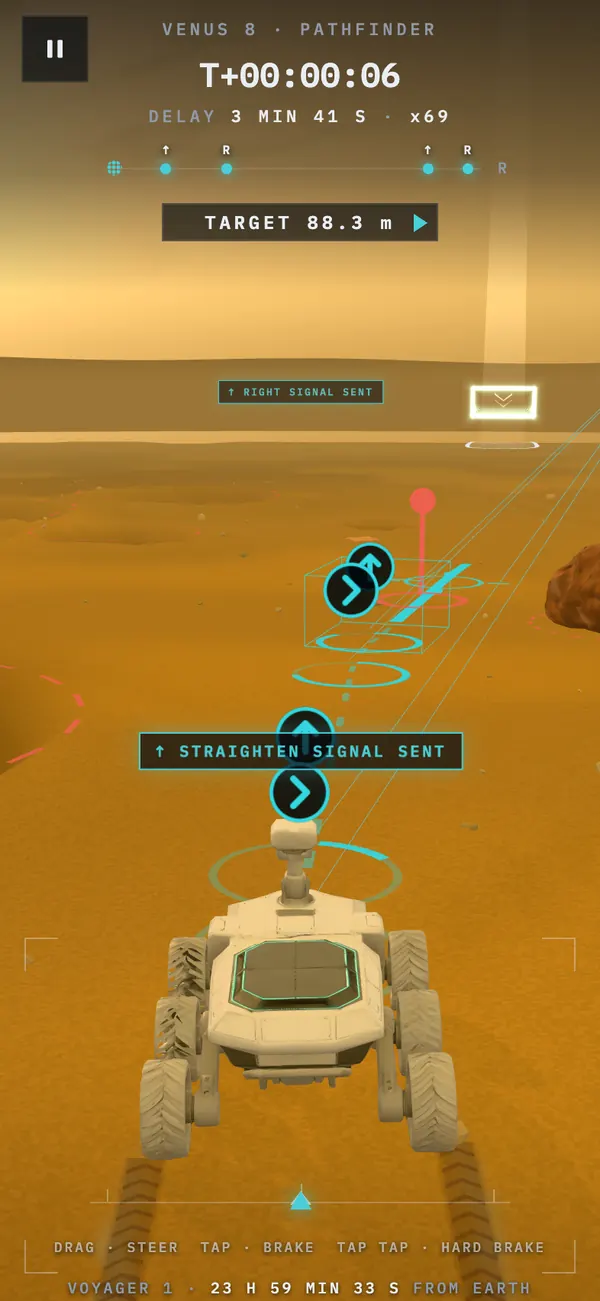
Thick yellow haze hides the ground ahead. Trust the ghost path, steer round what you cannot see yet and stop in the science ring. Venera 13 survived 127 minutes on this surface in 1982.
- Real one-way light
- 3 min 41 s (Venera 13, 1982)
- Today, live
- 3 min
- Time factor
- x69
- On screen
- 3.2 s
- Science ring
- 2.5 m radius
- Drive
- Haze drive
Real robots here: Venera 13 lander, 1982
-
04 24 stars on Venus
Phobos
The larger moon of Mars · grooved plains
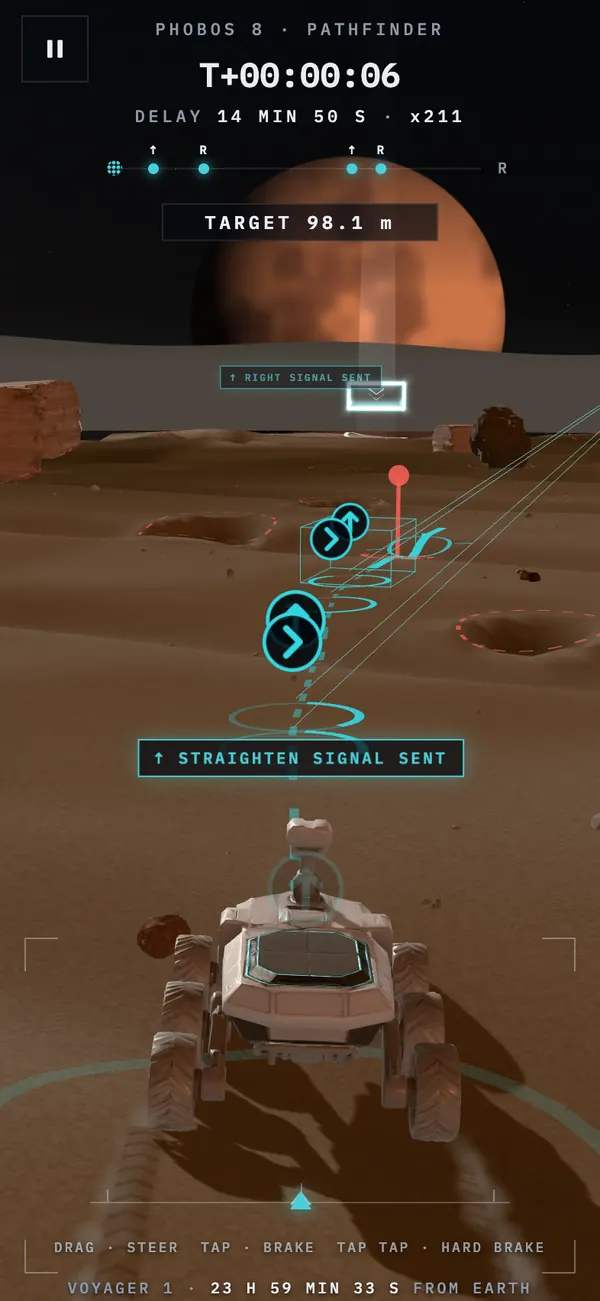
Mars fills the sky. Cross the grooves, weave round the boulders and stop in the science ring before the drop. The delay is set by the last signal from the Soviet Phobos 2 probe, in March 1989.
- Real one-way light
- 14 min 50 s (Phobos 2, 1989)
- Today, live
- 11 min
- Time factor
- x211
- On screen
- 4.2 s
- Science ring
- 2.4 m radius
- Drive
- Groove drive
Real robots here: Phobos 2, 1989 · the IDEFIX rover on Japan's MMX mission is planned
-
05 27 stars on Phobos
Ryugu
Near-Earth asteroid, 900 m wide
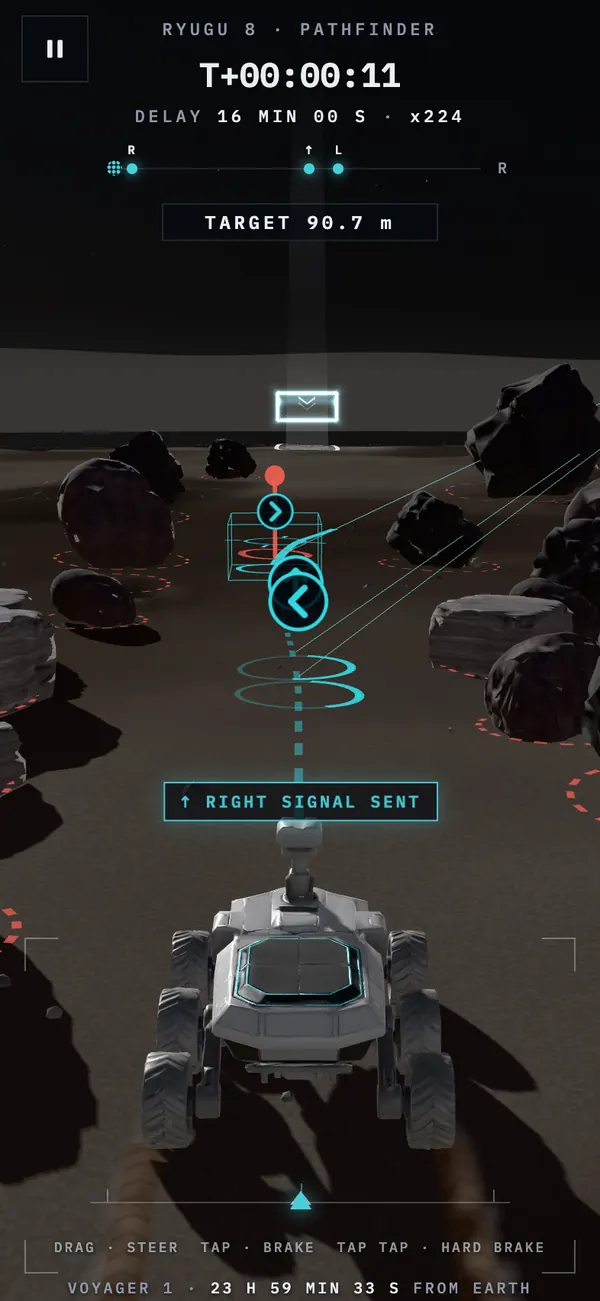
A rubble pile as dark as coal, where the hard terrain begins. Boulder fields hide one clear lane and boulder walls leave one narrow gap: find them and stop in the science ring.
- Real one-way light
- About 16 min (2018)
- Moment
- MINERVA-II hoppers land
- Time factor
- x224
- On screen
- 4.3 s
- Science ring
- 2.3 m radius
- Drive
- Boulder drive
- Boulder fields
- Boulder walls
Real robots here: the MINERVA-II hoppers and Hayabusa2, 2018
-
06 30 stars on Ryugu
Comet 67P
Agilkia, then Abydos
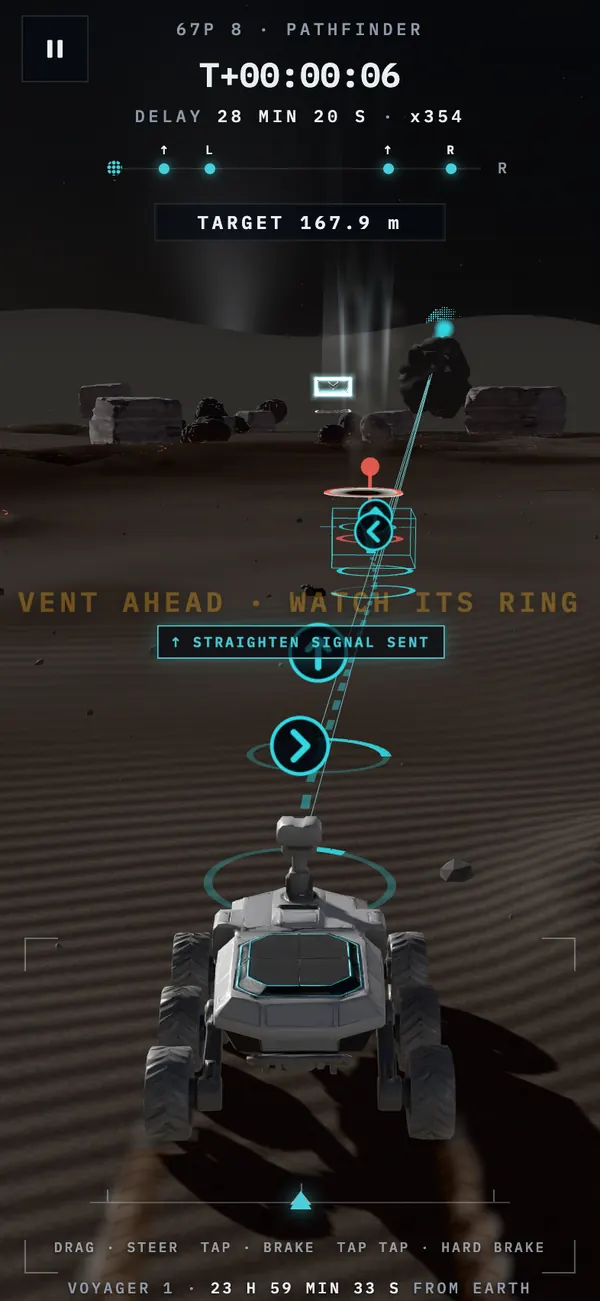
Dark dust over cliffs, jets venting into a black sky. Vents blow when their ring fills, so pass in the lull or steer round. Plan every turn early: from here out, even an autopilot needs a hand on the wheel.
- Real one-way light
- 28 min 20 s (2014)
- Moment
- Philae lands, 12 Nov 2014
- Time factor
- x354
- On screen
- 4.8 s
- Science ring
- 2.2 m radius
- Drive
- Comet drive
- Vents
- Boulder fields
Real robots here: the Philae lander and Rosetta, 2014
-
07 30 stars on 67P · 1 light-day of range
Europa
Moon of Jupiter · ice plains and double ridges
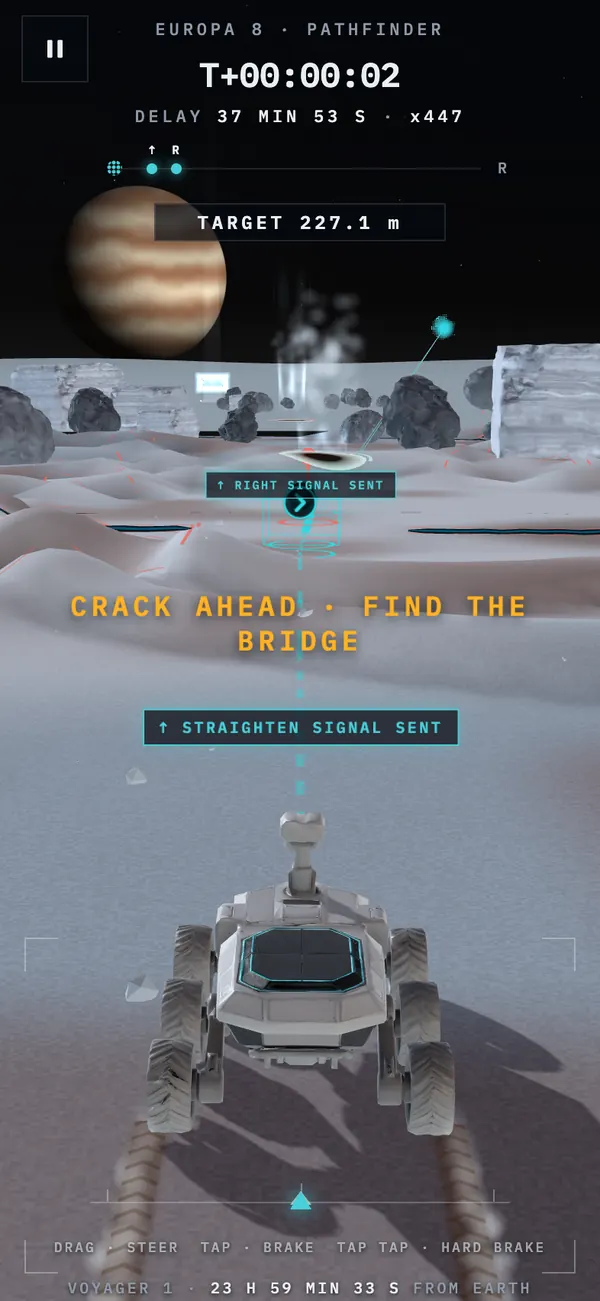
Cross the ice plain between the double ridges. Cracks swallow wheels, so cross where the ice bridges; vents, walls and boulder fields crowd the rest. Stop in the science ring at the fracture.
- Real one-way light
- 37 min 53 s (2030)
- Today, live
- 36 min
- Time factor
- x447
- On screen
- 5.1 s
- Science ring
- 2.1 m radius
- Moment
- Europa Clipper reaches Jupiter, 11 Apr 2030
- Cracks
- Vents
- Boulder walls
- Boulder fields
Real robots here: Galileo, 1995 to 2003 · Europa Clipper, arriving 2030
-
08 36 stars on Europa · 3 light-days of range
Titan
Moon of Saturn · methane dunes and lakes
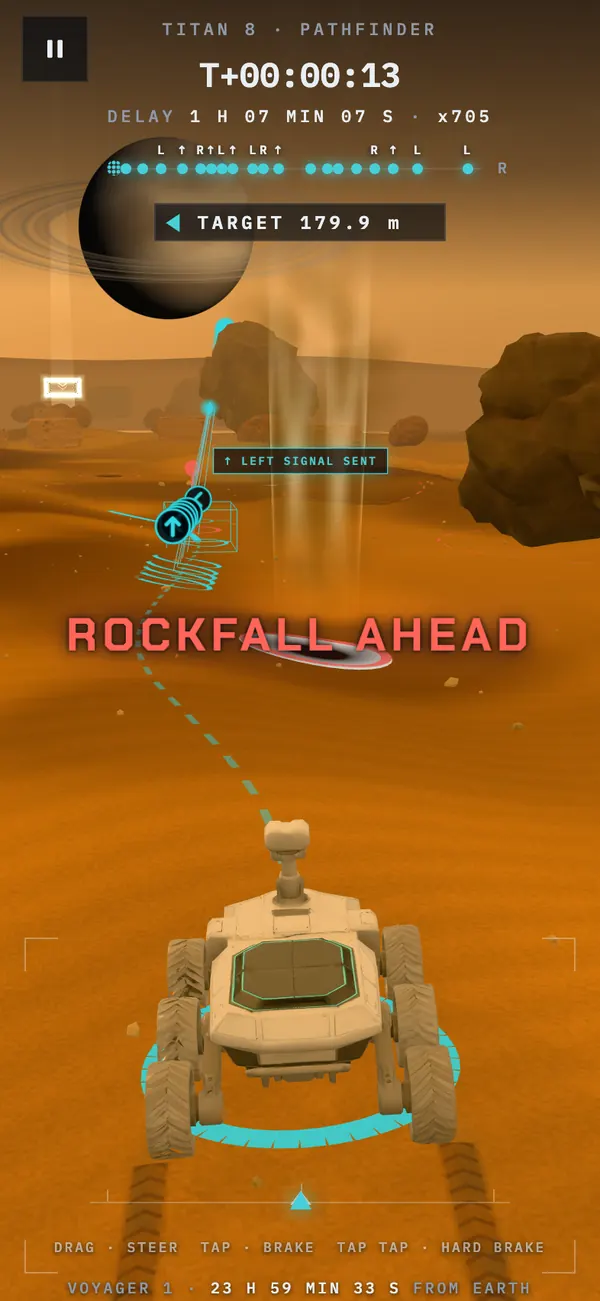
Orange haze over methane dunes, a full hour of light from home. Rockfalls drop a boulder on your path: when its shadow shows, steer round. Stop in the science ring at the shore.
- Real one-way light
- 67 min 7 s (Huygens, 2005)
- Today, live
- 72 min
- Time factor
- x705
- On screen
- 5.7 s
- Science ring
- 2.0 m radius
- Drive
- Dune drive
- Rockfalls
- Vents
- Boulder walls
- Boulder fields
Real robots here: the Huygens probe, 2005 · Dragonfly is planned
-
09 36 stars on Titan · 7 light-days of range
Enceladus
Moon of Saturn · tiger stripes and ice geysers
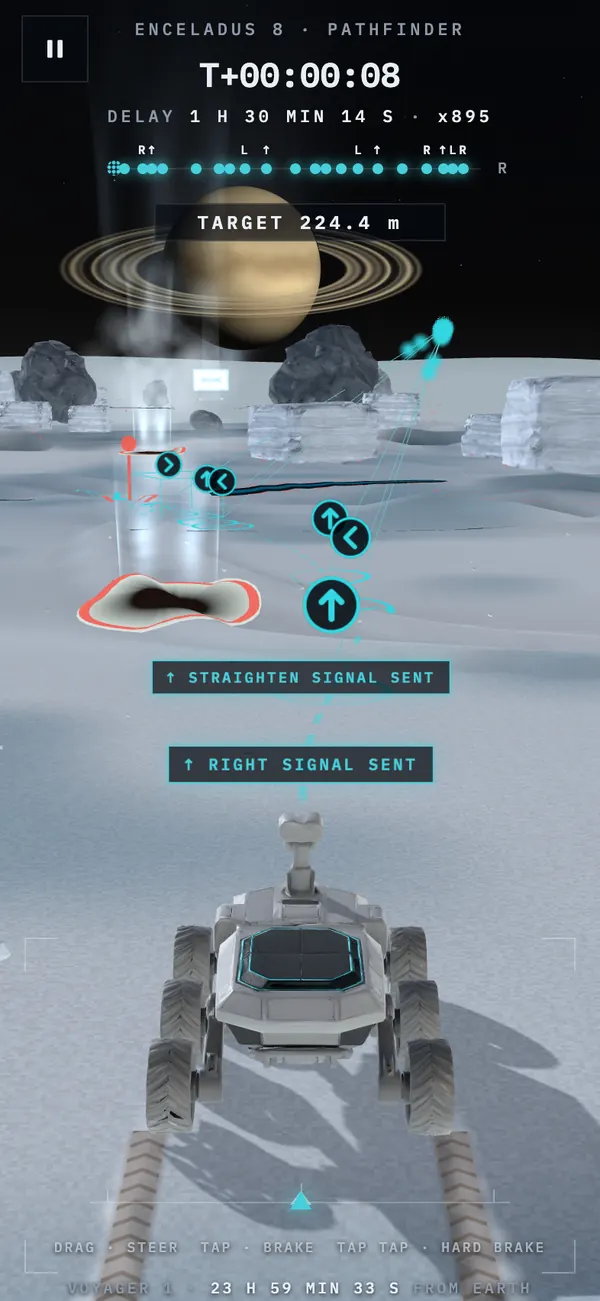
The brightest, most crowded ice in the solar system, under Saturn and the geysers. Every kind of hard terrain meets here, with the longest delay in the game and the smallest ring. Stop in the science ring at the tiger stripe.
- Real one-way light
- 90 min 14 s (2015)
- Today, live
- 72 min
- Time factor
- x895
- On screen
- 6.0 s
- Science ring
- 1.9 m radius
- Moment
- Cassini dives through the plume, 28 Oct 2015
- Vents
- Cracks
- Boulder walls
- Rockfalls
Real robots here: Cassini's plume dives, 2008 to 2015
10 Past the last world
Then there is deep space.
Voyager 1 has no ground to drive. It closes the list as the yardstick your range is measured against: one light-day from Earth. Cross a light-day of range yourself and the game marks deep space as reached.
Missions on each world use their own fixed course seeds, so mission 3 on Europa is the same ground for every driver. Stars never lock you out of anything you have already opened.