A tribute • Voyager 1
Light time from Earth to Voyager 1, live. One light-day: 18 Nov 2026, 10:16:07 UTC · Light time from Earth to Voyager 1, live. Past one light-day since 18 Nov 2026, 10:16:07 UTC
The farthest thing we ever built is about to be a day away.The farthest thing we ever built is now more than a day away.
Voyager 1 left Earth in 1977. On 18 November 2026 it becomes the first human-made object a full light-day from Earth: a command sent then takes a whole day to arrive, and the answer another day to come back.Voyager 1 left Earth in 1977. On 18 November 2026 it became the first human-made object a full light-day from Earth: a command sent to it now takes more than a whole day to arrive, and the answer another day to come back. Lightlag turns that waiting into the game.
If you sent it a message right now
Times in your time zone, from the NASA JPL Horizons range
- Leaves Earth
- Now
- Reaches Voyager 1
- Tomorrow
- Its reply reaches Earth
- In two days
Right now the gap grows by about 27 km every second (Earth's own orbit changes that through the year), so a message chases Voyager 1 for a few extra seconds. The distance is 25.9 billion km, about 173 times the distance from Earth to the Sun.
01 Forty-nine years out
The long way to a light-day.
Every kilometre of Voyager 1's path added light time between it and the people who fly it. The team still sends it commands, and still waits for the answer.
- Launch
Voyager 1 lifts off from Cape Canaveral on a Titan IIIE, sixteen days after its twin, Voyager 2.
- Jupiter
Closest approach to Jupiter, and the discovery of active volcanoes on Io.
- Saturn and Titan
A close pass of Titan bends its path up and out of the plane of the planets, toward interstellar space.
- The Pale Blue Dot
Looking back from about 6 billion km, it photographs Earth as a single point of light.
- The farthest object
It passes Pioneer 10 to become the most distant thing people have ever made.
- Interstellar space
It crosses the heliopause, the edge of the Sun's bubble of solar wind.
- The long-distance repair
After months of garbled data, engineers move code around a failed memory chip, about 22.5 light-hours away, and the science returns.
- One light-day
The distance light covers in a day: about 25.9 billion km.It crossed the distance light covers in a day: about 25.9 billion km. Every second it moves farther.
02 In the game
Built around one day of light.
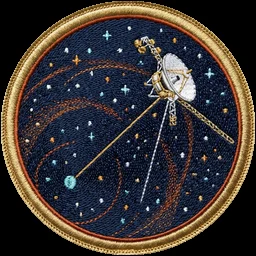
Lightlag opens on Voyager 1 reaching a light-day and closes its list of worlds with it, as deep space: no ground to drive, just the yardstick for everything else.
- RangeYour rank is the light your commands have crossed. Reach one light-day, as far as Voyager 1, and STRIDER joins your fleet with the One Light-Day patch.
- Voyager DayDrive on 18 November 2026 (UTC) to earn the Voyager Day patch, a once-only badge.
- The momentWith reminders on, the game tells you the moment Voyager 1 crosses the line.
Voyager 1 is operated by NASA's Jet Propulsion Laboratory. Lightlag and T-PLUS are independent and not affiliated with NASA or JPL. The one light-day moment is computed from the NASA JPL Horizons range, the same data behind the T-PLUS solar system explorer.